
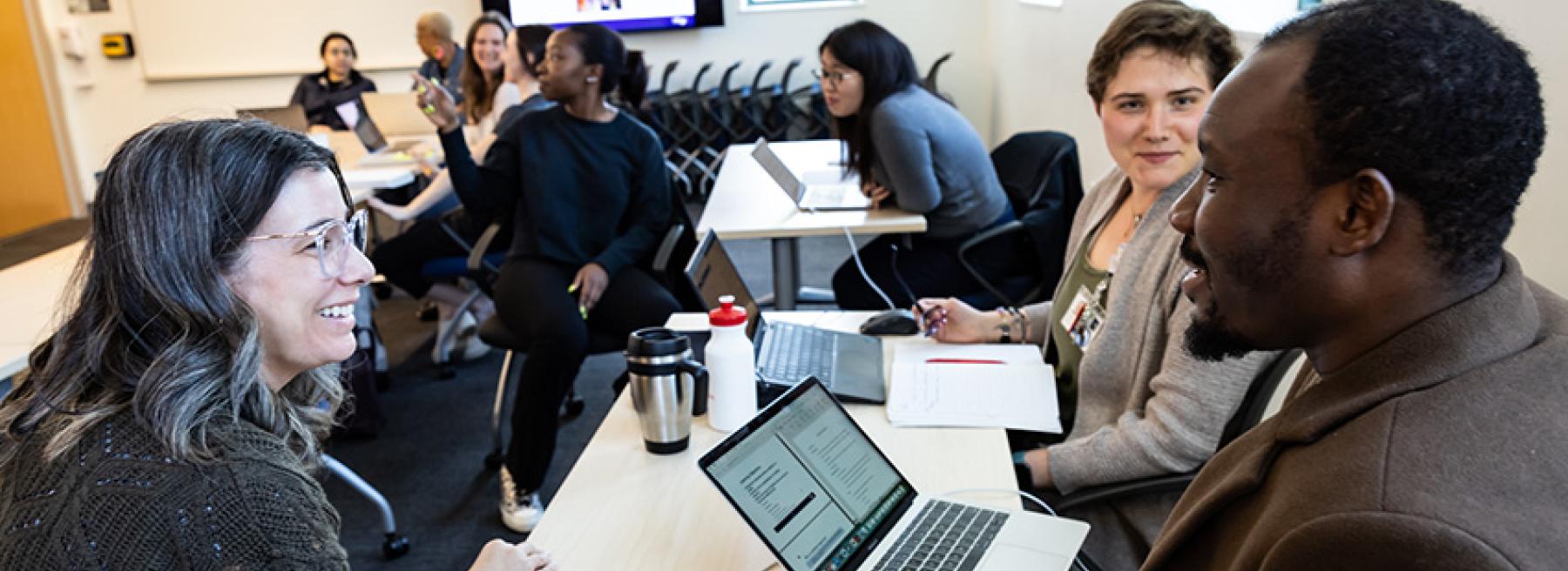
Welcome to the UCSF PhD in Nursing program.
Nursing science has never been more important. The challenges facing health and health care are increasingly complex, and addressing them requires scholars who combine scientific rigor and creativity with a deep understanding of people and communities. UCSF's PhD in Nursing program is designed for nurses who are ready to ask consequential questions and generate the knowledge needed to improve health and health care.
At UCSF, students pursue these questions within an extraordinary health sciences environment. They learn from and collaborate with faculty across the School of Nursing and the broader UCSF community, engaging with researchers and clinicians whose perspectives broaden how they understand a problem and strengthen how they approach their own science.
As director of the PhD in Nursing program, what I value most is seeing students grow into independent scholars. Earning a PhD involves more than completing coursework or a dissertation. It means learning to identify meaningful questions, develop a rigorous program of research, communicate findings clearly, and contribute new knowledge to the field. That growth depends on mentorship, intellectual curiosity, persistence, and a community of colleagues who will both challenge and support you along the way.
Our PhD faculty form a rich interdisciplinary community of nurse scientists, clinicians, sociologists, epidemiologists, health policy scholars, and implementation scientists. Collectively, they examine how biological, psychological, social, environmental, institutional, and policy factors shape health across the life course. Health equity is a unifying commitment across this work, with particular attention to historically excluded populations and communities experiencing structural disadvantage in the United States and globally. Faculty expertise spans HIV and infectious diseases; substance use, mental health, and trauma; symptom science and chronic illness; cardiovascular health, cancer, and diabetes; reproductive and maternal-child health; aging, dementia, and caregiving; occupational and environmental health; patient safety; health workforce development; and nursing education. Our faculty also bring growing expertise in artificial intelligence, digital health, clinical informatics, precision health, genomics, biomarkers, and other omics-based approaches.
This breadth of subject-matter expertise is matched by methodological strength. Faculty use quantitative, qualitative, and mixed methods; epidemiology and biostatistics; community-based participatory research; ethnography; clinical and randomized trials; intervention development; implementation science; health services and policy research; causal inference; large administrative and clinical datasets; and advanced biological and computational methods. Their scholarship extends from molecular and individual-level mechanisms to health systems, communities, workforces, and public policy. For students, this range creates opportunities to develop rigorous, interdisciplinary programs of research that connect discovery and theory development with intervention testing, implementation, policy translation, and measurable improvements in health and health care.
Our doctoral students are active contributors to this community. Each brings experiences, questions, and perspectives that enrich our collective work. We encourage students to develop a scholarly identity that is distinctly their own while building the skills, mentorship, and relationships that will sustain them throughout their careers.
I invite you to explore our faculty, learn about the research taking place across the School of Nursing, and consider how your own questions might grow within the UCSF community. We are looking for curious, thoughtful scholars who want to help shape the future of nursing science and improve health for the communities we serve.
 Orlando Harris, PhD, MPH, FAAN
Director, PhD in Nursing Program
UCSF School of Nursing