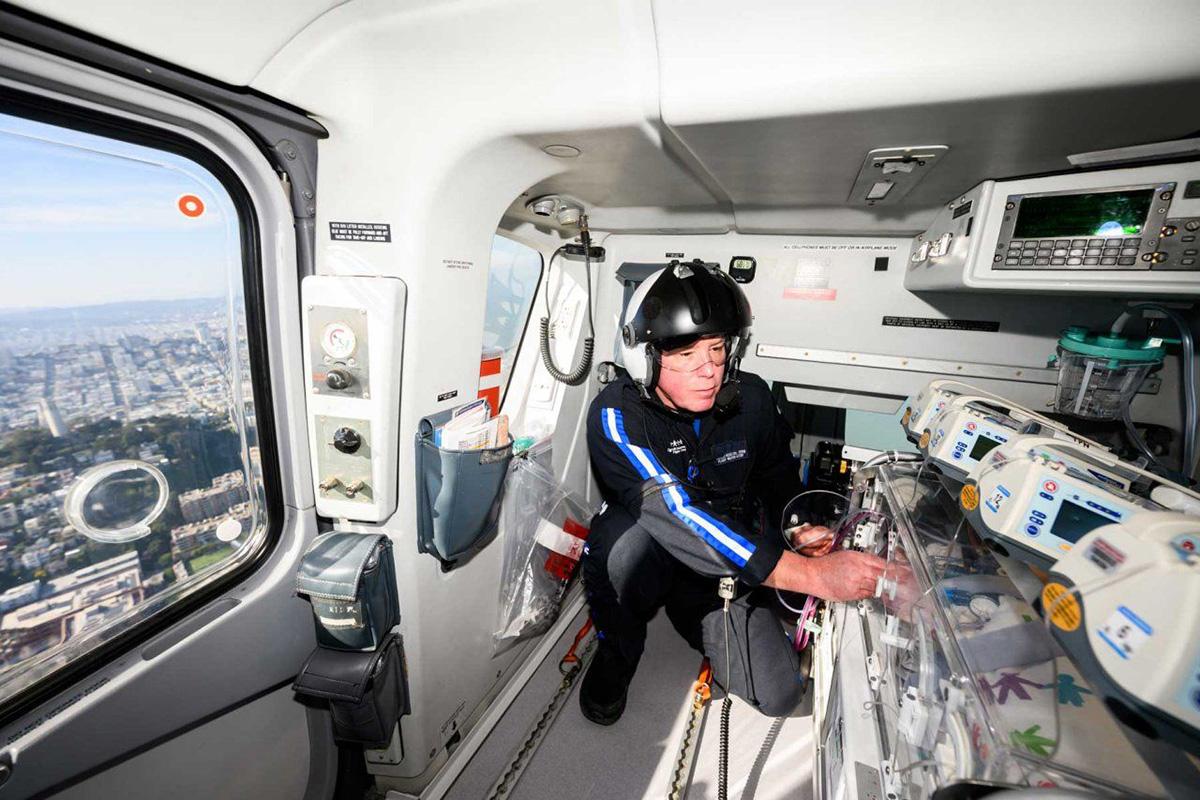
UCSF flight nurse Charles Hood works aboard UCSF’s Benioff Hospitals’ emergency transport helicopter Bear Force One. Photo by Noah Berger
These Nurses’ Research Could Help Save You or Your Child’s Life
From airlifting acutely ill babies to adult diabetes education, UCSF clinical nurses are advancing innovations in care based on rigorous scientific research.
As a critical care transport nurse, Charles Hood, RN, CFRN, has rushed hundreds of newborns, children, and teenagers to UCSF Benioff Children’s Hospitals in San Francisco and Oakland for life-saving treatment.
He instinctively knows where to find the necessary catheters, medication, and machinery in the cramped aircraft cabin of Bear Force One — UCSF’s Benioff Hospitals’ emergency transport helicopter. When seconds are crucial, he calmly administers complex treatments despite occasional turbulence and monitors his patient’s vital signs as if in a hospital critical care unit. Except his working space is one-tenth the size.
“These are the sickest patients you are going to see,” Hood said. “We’re attempting to do high-level neonatal intensive care unit (NICU) and pediatric intensive care unit (PICU) care in the back of a confined space with limited resources. You have to think fast and know how to manage the patient when their condition changes.”
Hood, who is passionate about his work, came up with the idea to expand UCSF’s critical care transport team to serve children throughout the state and region, but was surprised there were no existing training courses for the helicopter’s essential instrument that helps newborns breathe.
“We needed more staff trained to operate high-frequency ventilators during transport in order to meet the need for our most critical neonatal and pediatric patients, but there were no formal training modules that we could all refer to,” Hood said. “I realized we’d have to create them ourselves.”
Dynamic Duo: Clinical Nurses and Nurse Scientists
Hood received a Clinical Nursing Research (CNR) grant to develop and test a training program for the ventilator. The one- to two-year grant, jointly administered by UCSF Health’s Center for Nursing Excellence and Innovation (CNEI) and UCSF’s School of Nursing, pairs clinical nurses with PhD-prepared nurse scientists to conduct research in areas that aim to improve patient care and outcomes.
The 30-year-old program has supported around 50-60 research projects, some projects end up being incorporated into patient care protocols and published in major peer-reviewed journals like Applied Nursing Research, Journal of Patient Experience, and Journal of Infusion Nursing.
“We support frontline nursing research that has a direct impact on patients,” said Maria Yefimova, PhD, RN, lead nurse scientist of the Research and Scholarship team at CNEI and assistant adjunct professor, Department of Physiological Nursing, UCSF School of Nursing. “It isn’t theoretical, it’s research rooted in what nurses see and do every day. Clinical nurses and faculty are equal partners here — it’s truly collaborative.”
For his project, Hood partnered with Sandra Staveski, PhD, RN, associate professor for the School of Nursing and pediatric complex care nurse scientist, whose expertise he relied on to navigate the research grant writing and management processes. He also collaborated with Mandeep Chadha, MD, clinical professor with the Division of Pediatric Critical Medicine, to design video and simulation training modules for the high-speed ventilator.