
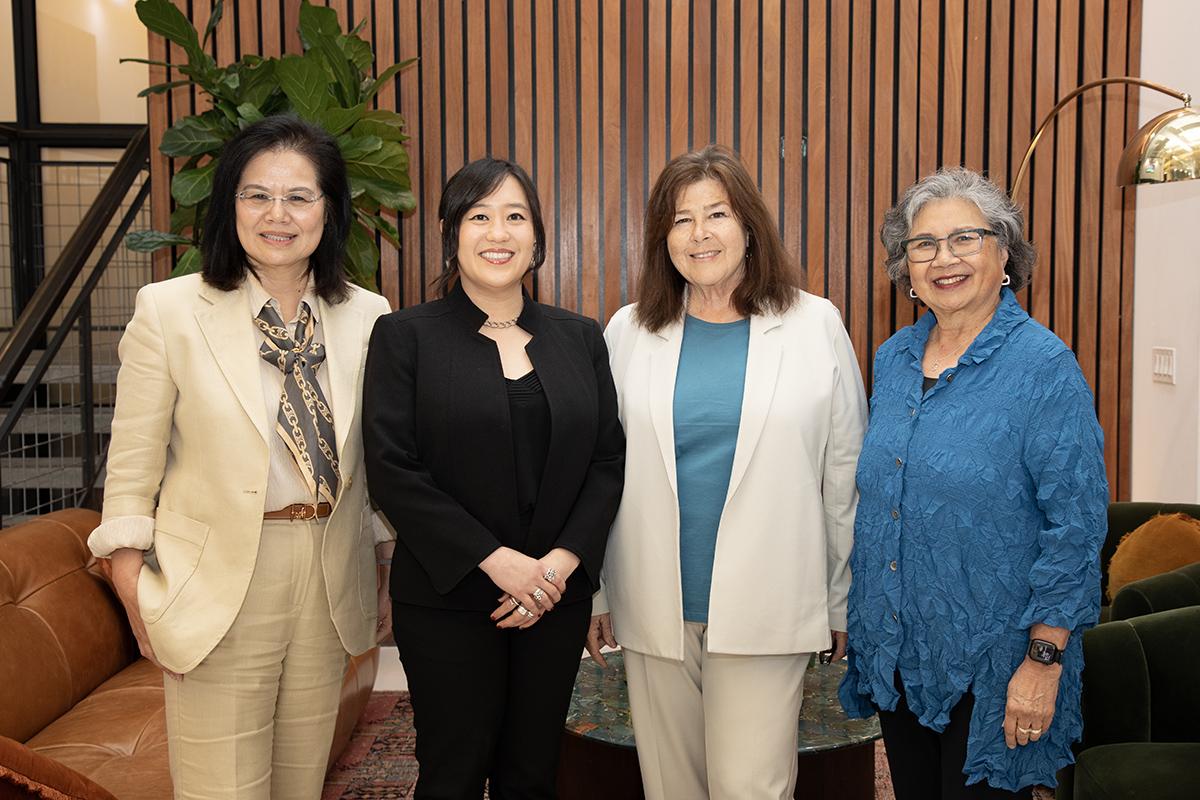
Jian Zhang, DNP, MS ’92, FAAN; Jarmin Yeh, PhD ’20, MPH, MSSW; Carol Dawson-Rose, PhD, RN, FAAN; and Jennie Chin Hansen, MS ’71, RN, FAAN, at the inaugural Dean’s Lecture. (Photography by Cindy Chew)
Three UCSF School of Nursing graduates discussed how the unique perspectives of nurse leaders can help shape a more resilient health care system.
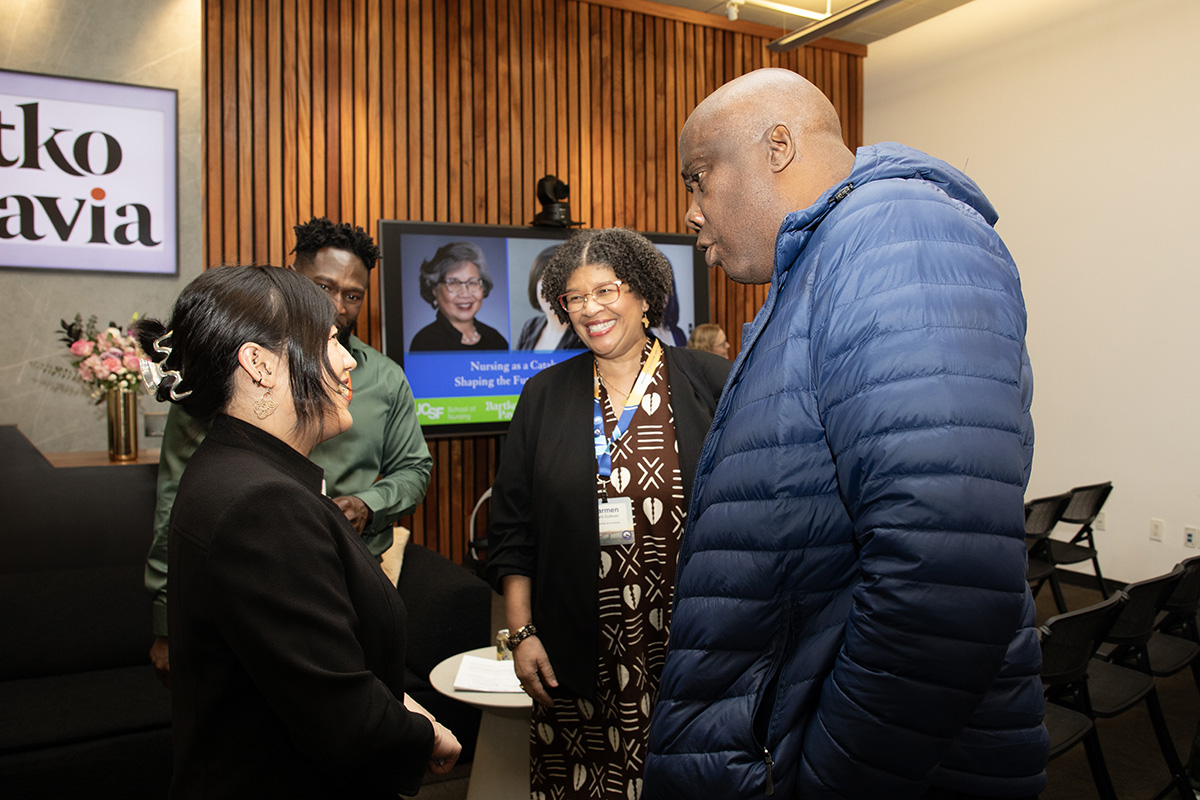
“At the UCSF School of Nursing, we think a lot about how we are going to improve health,” said Dean Carol Dawson-Rose, PhD, RN, FAAN, welcoming a crowd of alumni, students, faculty, and friends to the school’s inaugural Dean’s Lecture, co-sponsored by Bartko Pavia, on Thursday, April 23.
She celebrated the UCSF School of Nursing’s historical strengths in delivering patient care, investigating community needs, and — her favorite — working to improve health care systems, as she described the motivation for the new discussion series, which will focus on innovators who took perhaps a less-traveled path to nursing leadership.
“My hope is that you leave this evening with a sense of what’s possible,” she said.
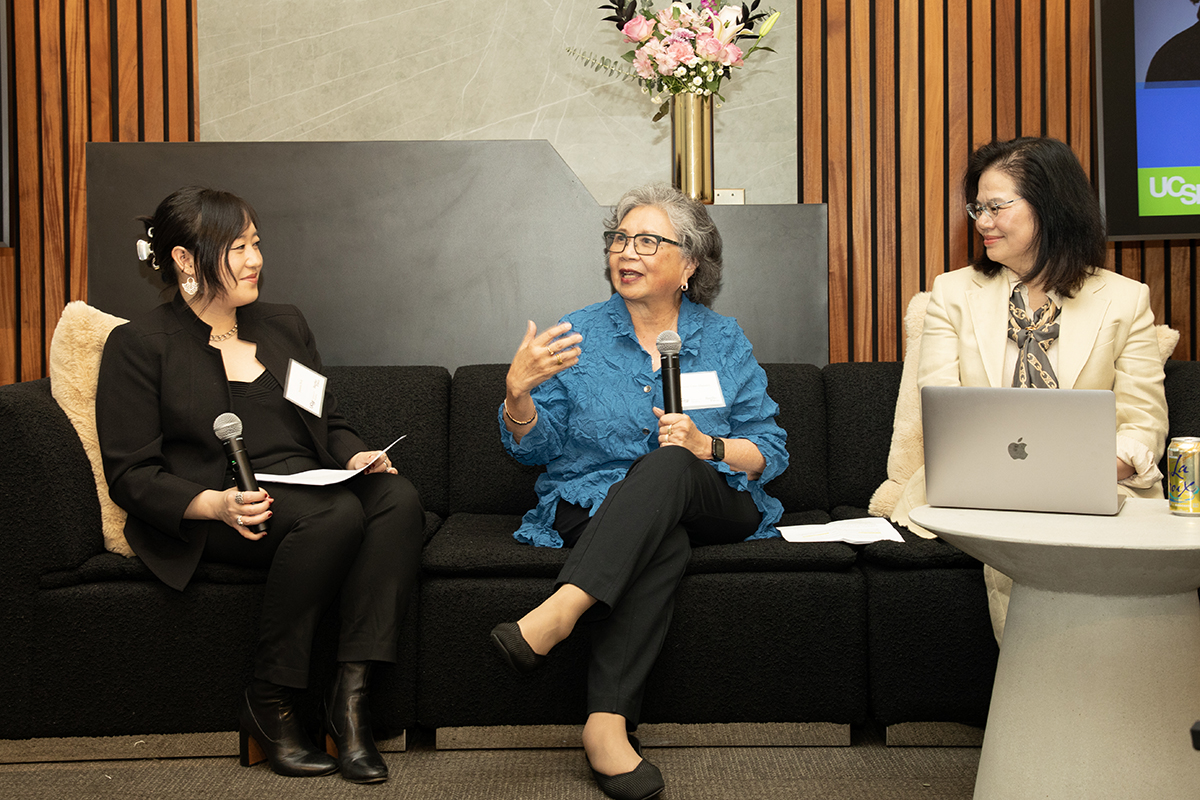
The event marked the beginning of UCSF Alumni Weekend by convening three prominent School of Nursing alums for the panel discussion “Nursing as a Catalyst for Systems Change: Shaping the Future of Health Care in California.”
Offering multidisciplinary perspectives, the panelists spoke of the nonlinear, often “curly” journeys they took to leadership in practice, policy, and research.
How Paths Shape Perspectives
“Nursing is never just about care delivery,” said moderator Jian Zhang, DNP, MS ’92, FAAN, former CEO of Chinese Hospital in San Francisco and clinical professor at the UCSF School of Nursing, to launch the discussion. “It is about seeing the whole system and having the courage to change it.”
Jennie Chin Hansen, MS ’71, RN, FAAN, former president of AARP, commissioner for the Future of Medi-Cal Commission, and recipient of a 2022 UCSF Medal, agreed.
“At the core, we want to make sure that care and lives are better," she said. “That's the mission that drives all of us, but we can express it in different ways.”
She described the development of the Program of All-Inclusive Care to the Elderly (PACE), a holistic care delivery system that she piloted at On Lok Senior Health Services in San Francisco, which is now a federally established Medicare benefit available in 31 states.
“Being part of policy was not on my radar, when I started nursing school 55-plus years ago,” she said.
A diverse disciplinary training, in social work, public health, and sociology, shaped the perspective of researcher Jarmin Yeh, PhD ’20, MPH, MSSW, an associate professor at the Institute for Health & Aging in the UCSF School of Nursing and advisory group member for the Future of Medi-Cal Commission.
She also credited her personal experience as a daughter of immigrants and woman of color for how it informs her thinking about how people navigate complex systems.
“When I make my decisions as a researcher, teacher, and advocate, I look to my ancestors, and all of those that have paved the way for us.”
What Keeps Them Going
The panelists took the opportunity to share what motivated them through the most challenging parts of their journeys.
Jian Zhang described how she, her colleagues, and her patients at Chinese Hospital were targeted for xenophobic abuse during the height of the COVID-19 pandemic.
“People literally broke into my car,” Zhang said. “They spit on my face.”
What kept her going in those difficult days? She recalled the first weeks of her clinical rotation at Chinese Hospital, during which she cared for a 29-year-old woman who’d been diagnosed with late-stage breast cancer. As her training progressed, she continued to encounter an unexpected number of young breast cancer patients with terminal disease.
Zhang went on to build a Chinese-language breast cancer awareness program, increasing the scale and scope of her work, even as she rose in the ranks at Chinese Hospital.
Throughout the years, it was the faces of those early breast cancer patients that stayed in her mind — the way they so clearly represented the needs of the community.
Jarmin Yeh credited a “dogged fortitude” and a dedication to leaving the world better than she found it. She also stays close to the people she works with, seeking out mentors and likeminded colleagues.
“Find fun in it,” Yeh said. “Laugh. Keep things tangible for yourself.”
For Jennie Chin Hansen, “It’s about being humble.”
After she received her master’s degree, she worked as a nurse in rural Idaho. She quickly identified a real need in the community she served: For about a dollar a day, a part-time school nurse could help to address key public health concerns, such as substance use issues.
“So I did my technical work,” she said. “I had a report ready when I went before the school board.”
But her efforts went nowhere fast. The change, she realized, had to be driven by the community itself. So she armed parents with information, and after two years, the school district got the nurse it needed.
“But it was not from me,” Chin Hansen said. “Leadership comes from the community and the people who really have a stake in it.”