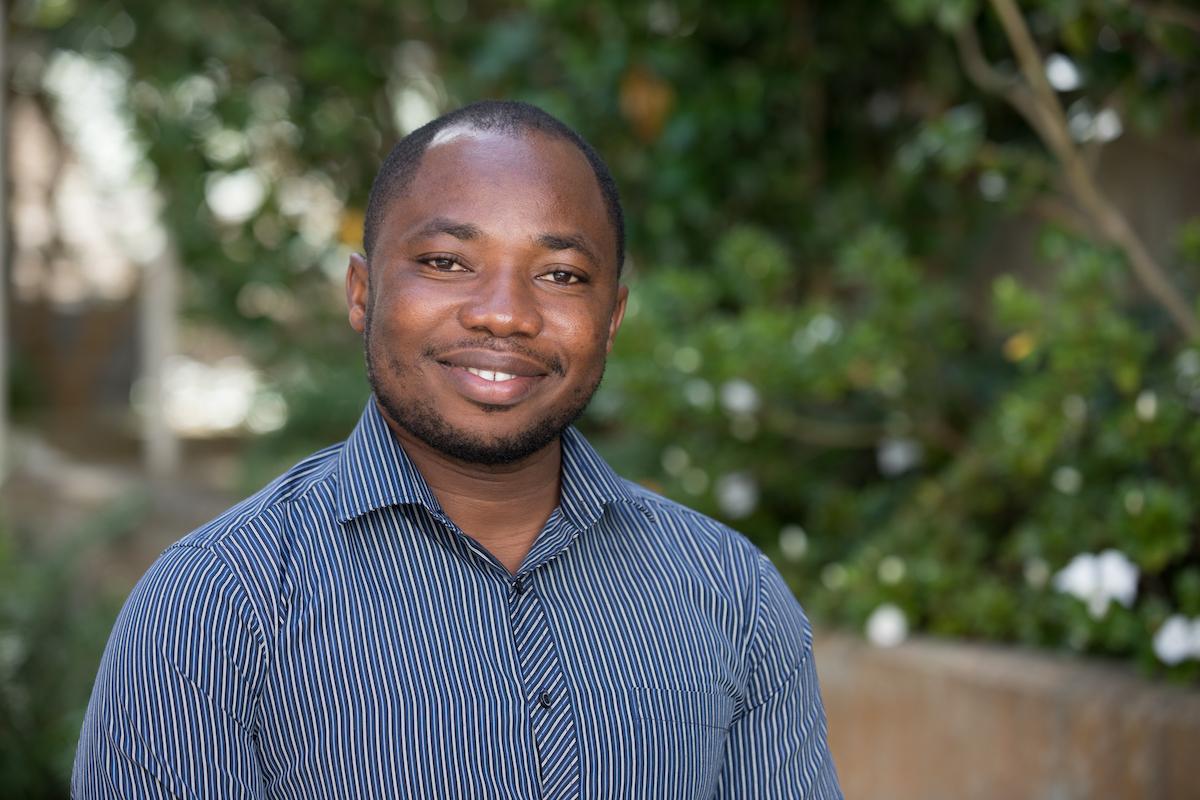
Jerry John Ouner, associate professor
Meet a Nurse Advancing Health Worldwide
Jerry John Ouner, PhD, RN, FAAN, is elevating nurses’ voices on the world stage to advance scientific discovery, transform patient care, and drive policy development nationally and globally. The UCSF associate professor recently completed a three-year term representing nurses at the United Nations and is now working with the National Institutes of Health as part of a national leadership group of nurse scientists advancing HIV care.
But what does he find most rewarding? Bringing new nurses into the profession and helping them forge their own paths.
Your research covers both maternal health and caring for people living with HIV. Did one interest come before the other?
Maternal health was first. I grew up in a very small community in Ghana with limited maternal health care services. When I finished high school, I worked for a nonprofit doing community education about HIV, which was my first encounter with HIV research. Both experiences inspired me to pursue a career in nursing. As a new nurse, my primary focus was caring for both children and their mothers.
How have you continued that work as a nurse scientist?
I completed my master’s degree at UC Davis where I focused on the social determinants of child mortality in Ghana. I anticipated pursuing that topic for my doctoral degree at Drexel University, but then I traveled to Zambia and saw — once again — the impact of HIV on maternal and child health. The experience was profound and inspired me to completely change the topic of my doctoral dissertation. Specifically, I wanted to understand water insecurity and its impact on HIV transmission from mothers to their babies.
When I came to UCSF as a faculty member, I connected with an exceptional community of people who are pioneering work in HIV. UCSF’s legacy as a global leader in HIV research, care, and policy expanded my understanding of what is possible within HIV research while keeping maternal and child health care at the center of my work.
You are working with the National Institutes of Health (NIH) as part of a nurse scientist leadership group on HIV research. How did you get involved with this work?
The UCSF-Bay Area Center for AIDS Research (CFAR) is one of just 20 such centers funded by the NIH in the United States. I’ve been a CFAR member since 2020, and it’s a privilege to now be working with other nurse scientists from across the country as part of the Inter-CFAR Nurse Scientist Leadership Working Group.
Despite the work nurses do in HIV research, nurses have been underrepresented in CFARs across the country with the majority of members coming from medicine or public health. The goal of our working group is twofold: raise awareness of nurses’ contributions to HIV research and increase the number of nurse scientists leading HIV care across the country.
Why must nurse voices be heard when it comes to HIV research, patient care, and policy development?
Nurses are the largest sector of the health care workforce globally. Nurses have direct contact with patients and are often the providers who spend the most time with patients. This allows nurses to understand patients’ day-to-day lives — identifying which care plans will work for each patient and which won’t.
Harnessing nurses’ perspectives to drive research improves the care and well-being of people living with HIV and is crucial to the development, implementation, and evaluation of policies to support those with HIV. Nurses can tell patients’ stories and advocate for patients — including patients living with HIV — to inform policies and research that contribute to social and behavioral interventions and pharmaceutical development. It’s very important to include nurses in every aspect of care for people living with HIV, from direct care, to research, to policy.
You recently completed a three-year appointment as the Sigma Theta Tau International Honor Society of Nursing’s representative to the United Nations. How was that experience?
I had the privilege of elevating nursing and nursing perspectives to one of the most influential organizations in the world. I represented nurses’ voices at high-level political meetings and at engagements involving member states on health-related issues, like the World Health Organization and UNICEF. It’s imperative that nursing is represented in these globally influential conversations.
What do you find most rewarding about being part of the UCSF community?
Mentoring new nurses, especially nurses from underserved populations. I work to be a voice for them and help them become what they want to be.
I see nursing as a very broad profession; you can use your nursing career to do anything. That’s especially true with new nurses and people who are aspiring to become nurses. I tell them about the opportunities nursing has presented me and can present them, and then mentor them on how to navigate and excel in their chosen profession.