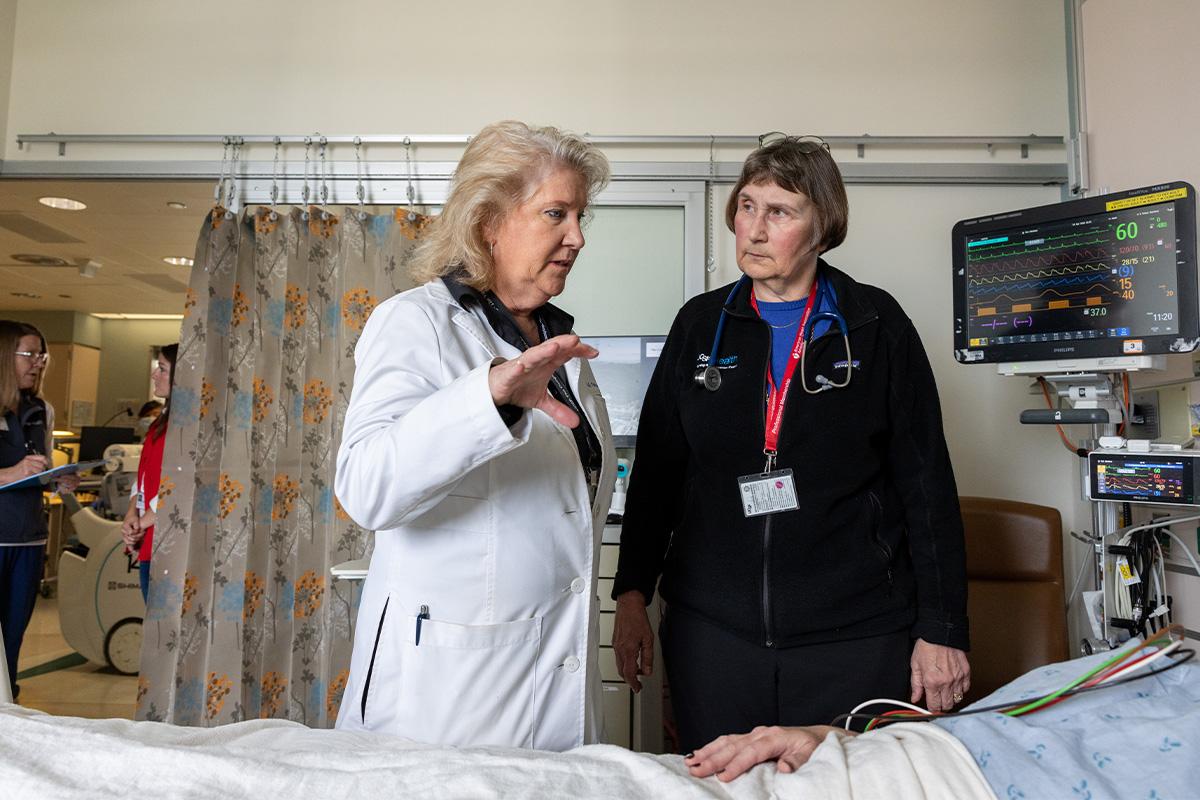
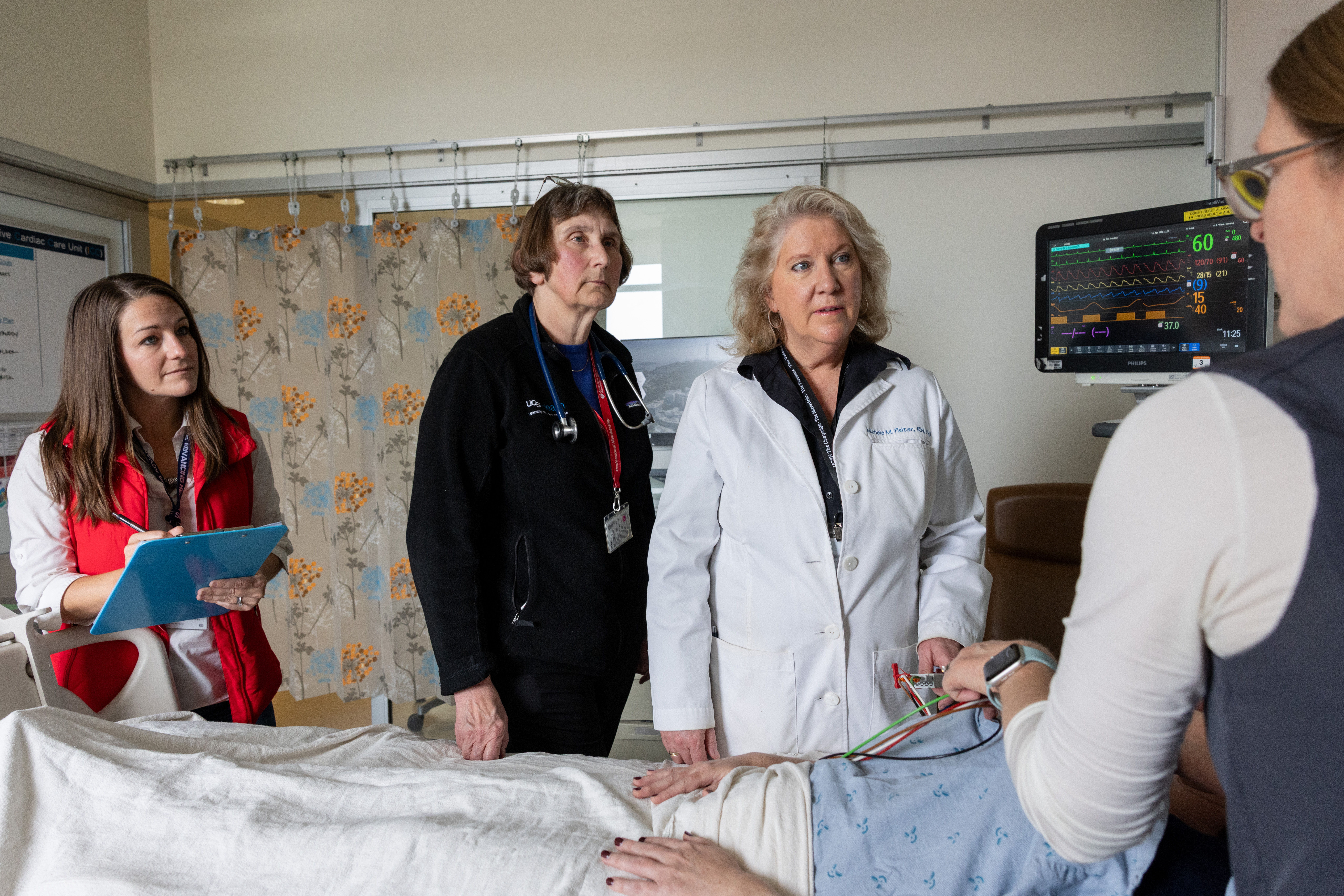
Michele Pelter, PhD, RN, professor in the School of Nursing (left), speaks to Kirsten Fleischmann, MD, MPH, professor in the School of Medicine, and a patient in a hospital room in the cardiac ICU at UCSF Helen Diller Hospital, Parnassus Heights campus.
Catching Cardiac Danger Earlier and More Accurately
Having a sudden heart rhythm event while hospitalized can be deadly. Lethal cardiac arrhythmias while hospitalized happen in two to 10 percent of patients. It's more likely to happen to those who are already coming in for care because of a heart attack — about 720,000 Americans will have a new heart attack event — and those who are admitted to an intensive or high acuity care unit.
And while bedside electrocardiographic (ECG) monitors can detect a dangerous change in heart rhythm that may signal a potential oncoming lethal arrhythmia, they are so sensitive that they generate false alarms constantly, which means nurses can become desensitized to these alarms.
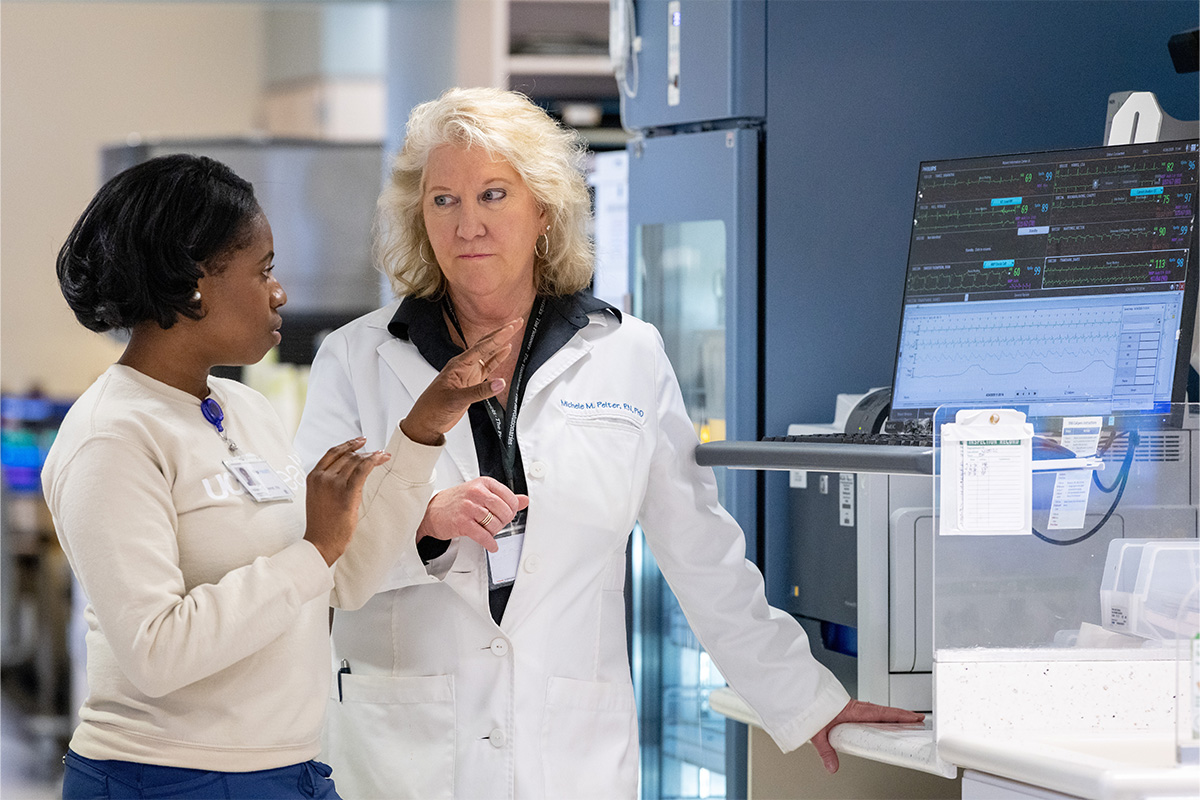
“They’re so sensitive that they can alarm from a patient moving in bed or brushing their teeth,” said Michele Pelter, PhD, RN, professor in the UCSF School of Nursing. “There are so many alarms, we have found that as many as 90% are false, that nurses start to assimilate the noise in their workflow and can miss true arrhythmia alarms through no fault of their own.”
But picking up lethal arrhythmias quickly can make a life-or-death difference, especially when it comes to ventricular tachycardia, where an irregular heartbeat starts in the bottom of the heart, causing rapid and inefficient beating. If sustained, survival is often dependent on patients receiving defibrillation within three minutes of arrhythmia onset. If false alarms are overtaking real ones, then that three-minute window can be missed.
Through a new National Institutes of Health (NIH) R01-funded study, Pelter is working with teams across the country to test better ways to catch when someone is having ventricular tachycardia by comparing three methods — bedside monitors currently in use, a signal processing model previously developed at UCSF, and a new, developing AI model.
“We want to get closer to identifying true ventricular tachycardia regardless of which of these three methods detects it,” she said.

UCSF’s Legacy of Heart Rhythm Studies
Studying this problem isn’t new at UCSF. Pelter and her team, which includes biomedical engineers and cardiologists, have been trying to solve it for more than a decade.
They started by working on a dataset of 5,320 UCSF ICU patients from 2013 to 2015. The team applied signal processing algorithms to analyze data for patterns to identify ventricular tachycardia and then annotated whether the potential arrhythmia was true or false. They looked at ECG waveforms, blood oxygen saturation, and where available, invasive arterial blood pressure and transthoracic impedance recordings.
In 2024, the FDA qualified the UCSF Lethal Arrhythmia Database (LAD) to be part of the Medical Device Development Tool program, which is intended to help medical device manufactures make their ECG devices more efficient and accurate. It’s also the single largest database annotated by clinical experts in an intensive care unit cohort in existence.
“That was our initial effort. Now, I think everybody has high hopes for AI. Our team wanted to test an AI approach and apply it to the data,” Pelter said.
A Three-Way Heart Rhythm Detection Competition
In the new study, which is funded through 2028, Pelter is doing just that. She and her team, which includes nurse scientists at the University of Rochester and the University of North Carolina, Chapel Hill, are using two datasets to see what works best at detecting ventricular tachycardia: current bedside monitors, an updated and improved version of their signal processing algorithm, or AI.
“We’re doing a head to head to head competition of all three systems,” she said.
They are using two different databases for this study. The first is the same one used to create the LAD, which is now part of the FDA toolkit. The second is a new cohort of 4,500 patients who were admitted to UCSF in 2024 and 2025. Half of the UCSF patients were in the ICU and half in a step-down telemetry unit where they also had continuous ECG monitoring.
“The good thing about AI is it can handle massive amounts of data. The drawback is that it’s not perfect,” said Pelter. For example, while the AI models can handle a lot of information, it’s had trouble working with continuous data, like the kind that these ECG monitors produce. The team has been trying different tactics, like shortening the data into 10-second clips, to see if it’s more successful.
It’s an ongoing process of learning a new technology that hasn’t been applied in these situations before. “People think AI can do everything plus make you a latte,” she jokes. “But it takes work.”
Improving Nursing and Patient Care
Pelter is not focused on which method comes out ahead. The goal is not to prove the superiority of one technology over another, but to provide accurate warnings of potential lethal arrhythmias, which means better in-hospital survival rates and overall patient care.
As a patient, hearing alarms can be terrifying, she said, and since these types of alarms only stop when a nurse turns them off, a patient can think “why aren’t they caring about me? It’s a really big issue for patients, their families, and nurses. We can do better,” Pelter said.
More effective and efficient detection also helps nurses provide better care without false alarms constantly drawing attention that might better be used somewhere else or desensitizing them to the point that they miss a true alarm.
If the current standard of bedside ECG monitoring is the least efficient model, the next step would be testing the developed algorithms in real time and adapting it as part of patient care. “How do you grab data on the fly, in real time, process it through your algorithm, and push it back within seconds for a nurse or doctor to see?” said Pelter. “That’s going to be our next challenge.”