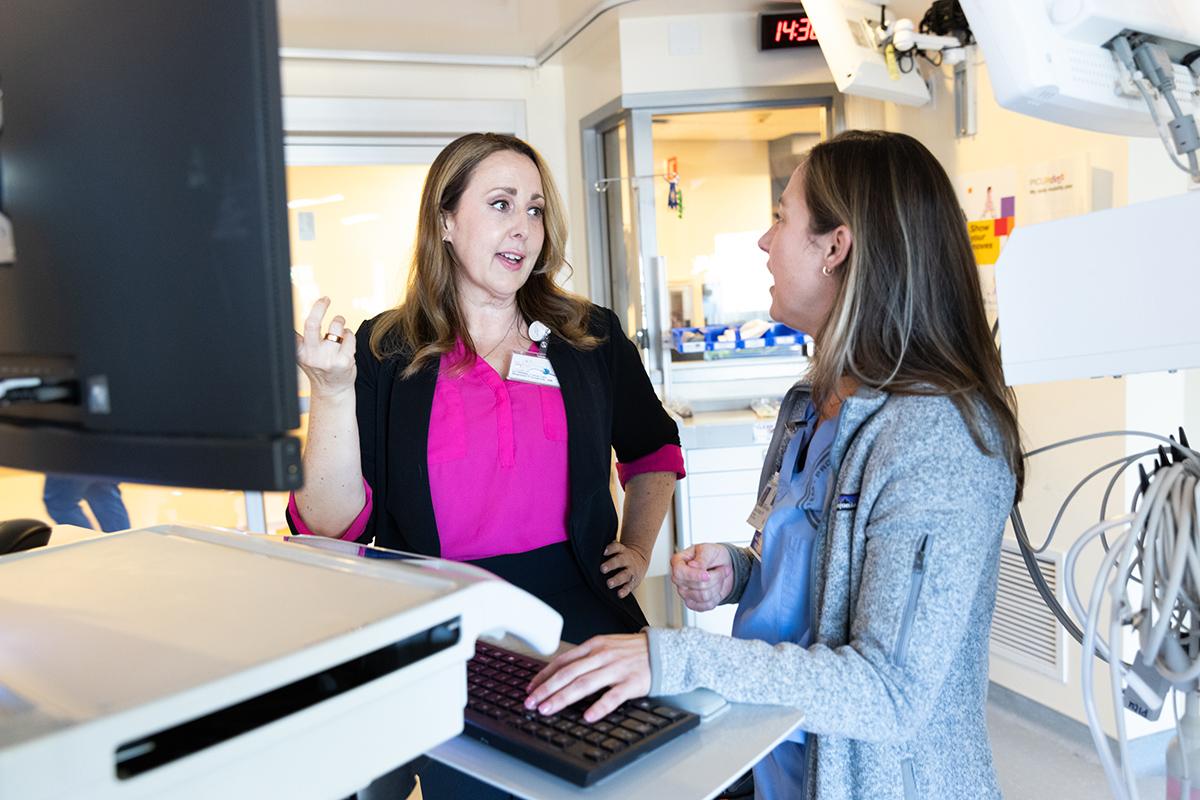
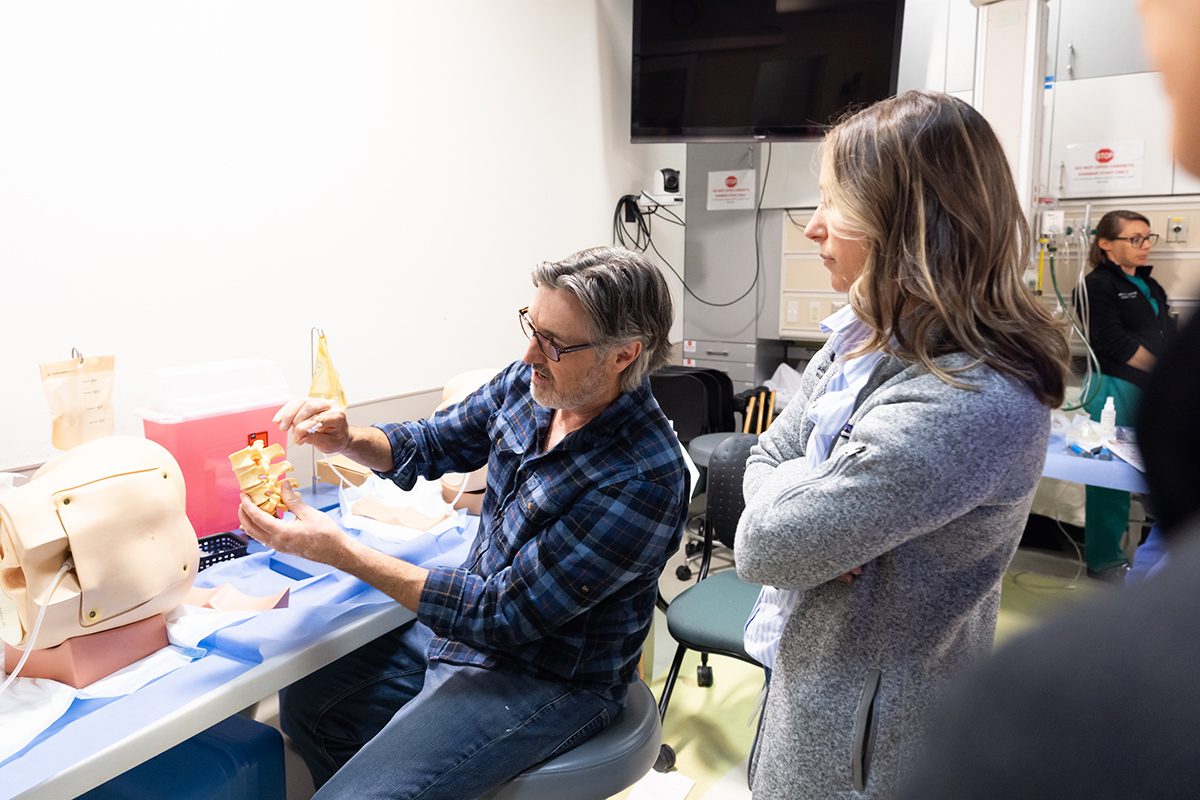
Student Jessica Butzer, RN (right), worked under the supervision of clinician Shannon Fitzpatrick, DNP ’25, RN, CCRN, on her doctoral quality improvement project.
Academic-Practice Partnership Improves Patient Care, One Project at a Time
From avoiding mistakes with dangerous medications to preventing painful pressure injuries, the scholarly projects addressed by learners in the inaugural cohort of the UCSF School of Nursing’s BSN Entry to the Doctor of Nursing Practice (DNP) pathway are helping clinicians at UCSF Health, and at medical facilities around the Bay Area, tackle some of their most complex problems.
Preparing for Any Context
To demonstrate the ability to execute evidence-based changes to clinical challenges, all DNP students must complete a scholarly project before graduation.
This scholarly project teaches students how to assess issues, review data-supported recommendations, implement changes, and evaluate the effects of their solutions, explains Miranda Surjadi, DNP, RN, ANP, professor and associate director of the School of Nursing’s BSN Entry to DNP pathway.
“We’re educating our students to be competent clinicians and nurse leaders, equipped with the skills to address complex health issues in many different settings,” she said.

The BSN Entry to DNP pathway, which gives nurses who hold a BSN the knowledge to innovate in an advanced practice specialty, is one of two DNP options the school offers. The school also prepares nurses who hold a master’s degree with leadership skills through the Post-Master's Entry to the DNP pathway.
While Post-Master's Entry to the DNP pathway students are usually already established in their units, students in the BSN entry program may not be as well-positioned to identify scholarly projects in their own workplaces.
That’s where the School of Nursing’s strong relationships with clinical affiliates — especially its academic-practice partnership with UCSF Health, which integrates research, education, and clinical care — connects learners directly to facilities in need of assistance.
Meeting the Needs of Clinicians

“There’s always an opportunity to improve things in health systems,” said Adam Cooper, DNP ’23, RN, NPD-BC, director of nursing continuous improvement and nursing research at UCSF Health and director of the UCSF JBI Centre within the UCSF Health Center for Nursing Excellence & Innovation.
“Academic-practice partnerships are intended to lift up both the school and the health care organization,” he said. “And there are so many amazing opportunities to do that within the UCSF community.”
Cooper worked with Emebet Aklilu, MPH, MSBH, director of engagement and operations in the School of Nursing's Office of Opportunity and Engagement, and UCSF Health leadership to identify areas where quality improvement assistance would be most welcome.
First on the list was patient safety. “Our top priorities are providing high-quality care and reducing harm,” said Cooper. Also named as focus areas were developing the nursing workforce and improving the patient experience.
All told, UCSF Health provided more than two-thirds of the cohort’s projects, matching students with clinical site liaisons across a broad swath of patient populations.
Preventing Medication Errors
To make efficient use of the UCSF Health clinicians’ time, students were assigned to projects in teams of two, or dyads, with each learner pursuing a separate scope of work on a similar topic.
Jamie Austin, RN, a trauma nurse at Oakland’s Highland Hospital, and dyad partner Alexandra Harris, RN, worked under the supervision of Shannon Fitzpatrick, DNP ’25, RN, CCRN, patient care director in the pediatric critical care services area at UCSF Benioff Children’s Hospital San Francisco and a graduate of the school’s Post-Master's Entry to DNP pathway.
The pair was tasked with helping to reduce errors in the administration of high-risk medications. Independent manual double-checks of high-alert medications by two different nurses can catch up to 95% of medication errors, but the double-check process must be clear and followed carefully.

“My project was educating the nurses in the cardiac intensive care unit on how to appropriately do a two-RN independent check,” said Austin, “because we found that there had been a drift on the execution.”
Austin was drawn to the DNP program to broaden her knowledge so she could make a bigger difference for her patients. Having just completed the implementation phase of her project, Austin is excited to analyze the effects of her efforts.
“I’ve felt like I’ve performed at my maximum capacity as a bedside nurse,” she said. “I wanted to be involved in change at a greater scale.”
Eliminating Pressure Injuries
Jessica Butzer, RN, a clinical nurse in the adult intensive care unit at UCSF Health’s Mission Bay medical center, and her dyad partner, Araceli Melchor Cruz, MSN, RN, also worked with Fitzpatrick. Their project aimed to reduce hospital-acquired pressure injuries, or HAPIs, which are caused by prolonged pressure, friction, or moisture on skin.
Commonly known as bedsores, HAPIs are difficult to treat and largely preventable. The emerging standard of care for prevention is a “four eyes in four hours” process, which mandates that two nurses perform a head-to-toe assessment together when a patient is admitted.
Already in use in the adult hospital, the practice was introduced into the pediatric care unit with Butzer’s project.
“What I was testing was an education bundle: Do nurses have more confidence in handling the assessment with a video, reference sheet, and hands-on demonstration, versus just a policy change in an email?” Butzer explained.
She, too, is pleased with her ability to make a larger impact on a patient population. “To find something that the evidence says works, and then do something that helps our facility as a whole, is awesome,” she said.
Powerful Partnerships, Healthier Patients
As the learners move into the data evaluation stage, program directors at the School of Nursing and UCSF Health are reflecting on the feedback they’ve received across the 23 scholarly projects.
So far? Rave reviews.
The education sessions offered by the DNP students have been well-attended by nursing staff, said Surjadi. “They seem very satisfied with the impact our students are having.”
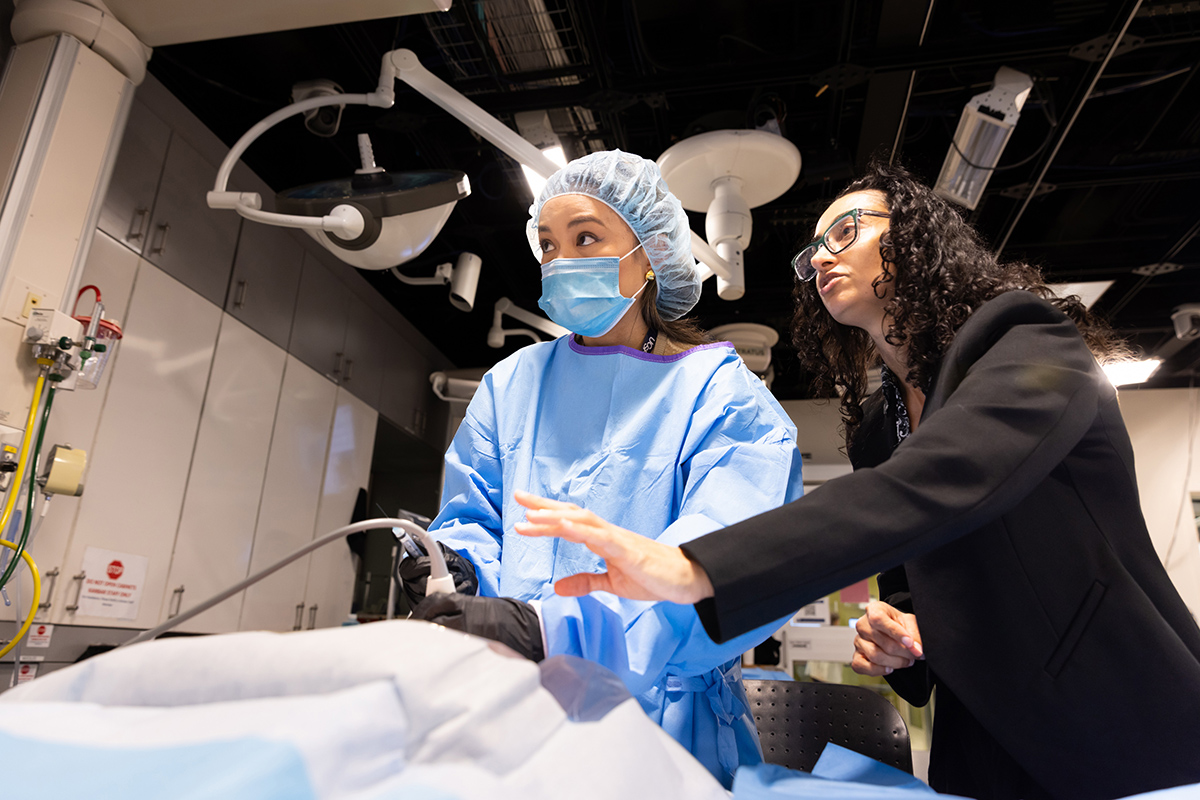
Cooper concurred. “So far, we have seen that this partnership has given our teams the capacity to advance projects that had previously been limited by time and resource constraints,” he said.
The health system plans to perform regular reviews of their quality improvement needs, to make sure that the projects students select are in line with UCSF Health priorities.
And while healthier patients are the greatest achievement of this expanded alliance, the sense of satisfaction is carried beyond hospital corridors.
“We’re excited with not only the work that’s being done, but the connections that are being made,” said Cooper.
“It’s showing how we’re stronger together.”