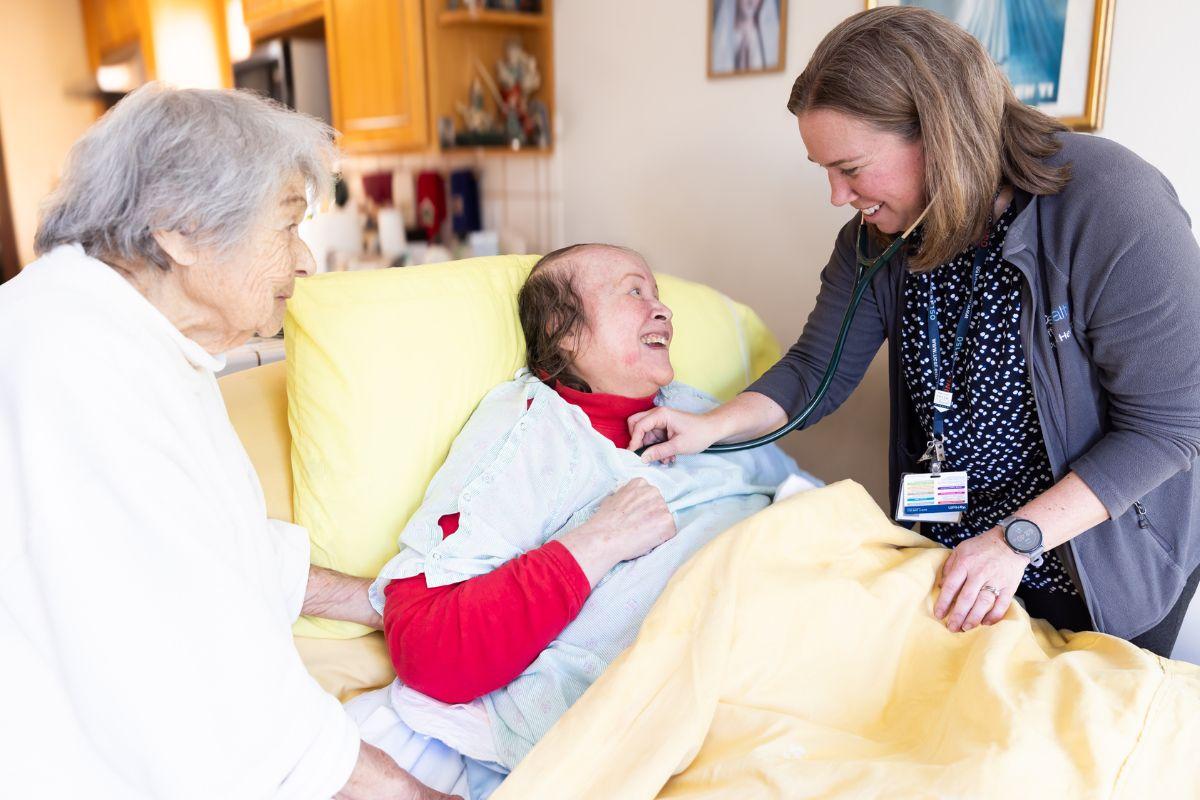
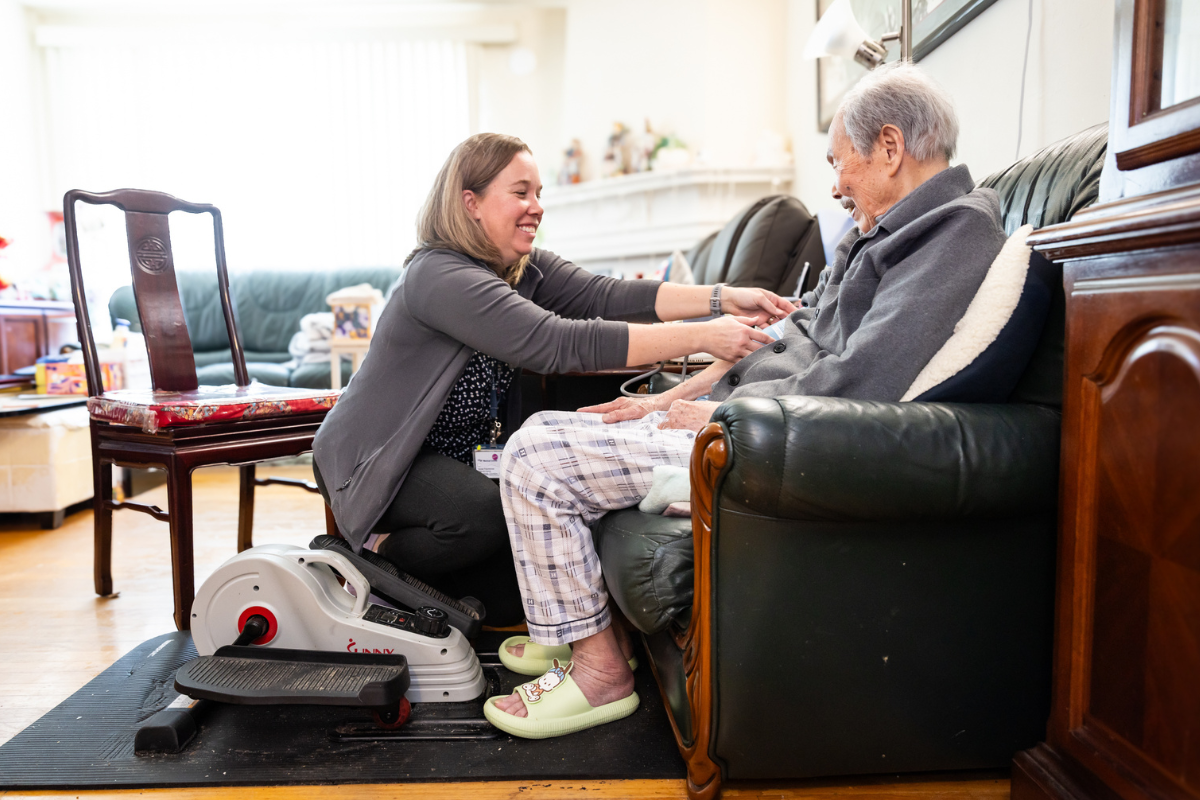
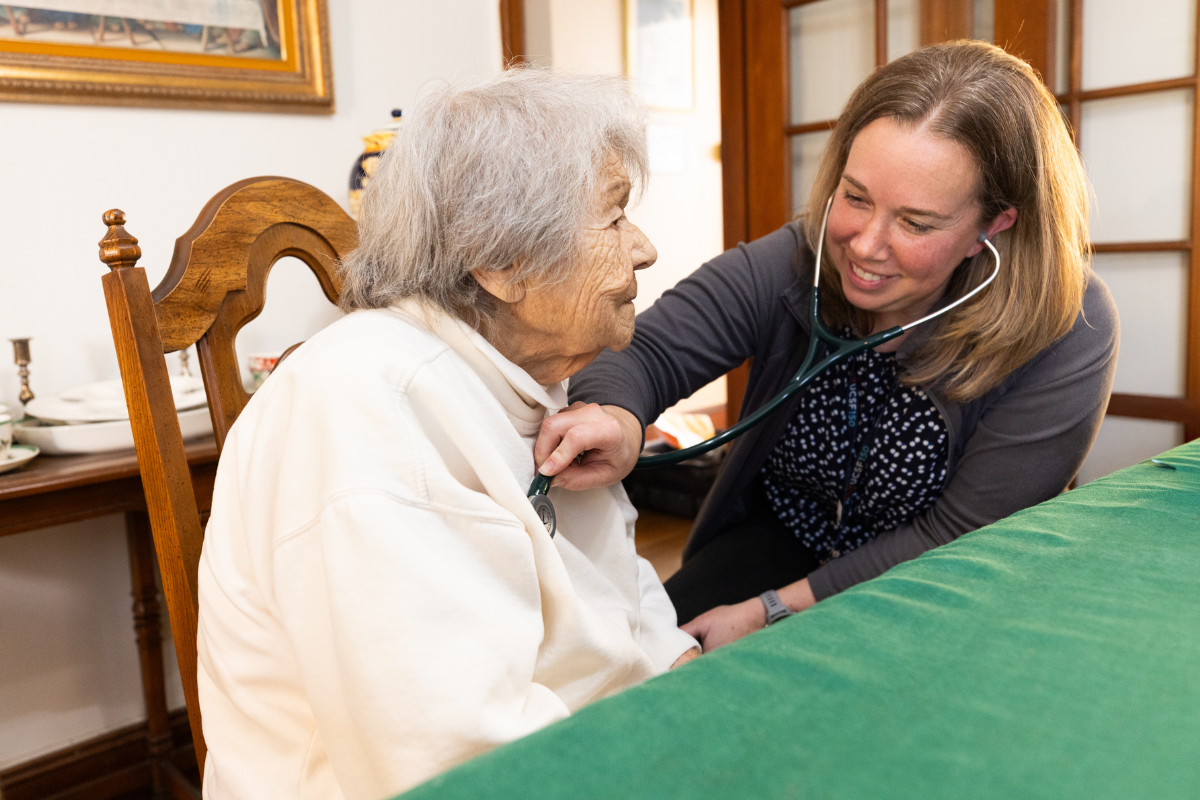
Courtney Gordon, DNP, NP (far right), who delivers home-based care to patients in San Francisco, helped launch a new learning collaborative to support other home-care providers. (Photography by Elisabeth Fall)
UCSF Launches Learning Collaborative to Strengthen Home-Based Care
Home-based care is a critical health care delivery method, serving as a lifeline to patients who face obstacles in traveling to medical appointments, such as older adults or those with mobility challenges.
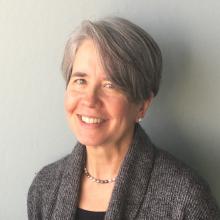
But while clinicians who provide home-based care may enjoy benefits like independence and flexibility in scheduling patient visits, it can be a lonely experience. They don’t have colleagues to talk to, consult with, or provide emotional support. "You're isolated out there and sometimes need someone to work things out with,” said Courtney Gordon, DNP, NP, a geriatric and palliative care specialist at UCSF who delivers at-home care.
Leveraging Technology to Improve Care
To help nurse practitioners and other health care providers working in this field, Gordon and colleagues at the UCSF School of Nursing recently launched the Home-Based Care Learning Collaborative ECHO, a free virtual learning community led by UCSF experts in geriatric and palliative care.
Through online sessions, home-based health care providers and advocates meet in an “all teach, all learn” environment to discuss complex patient cases or challenges they are navigating in their work, and to learn best practices from experts on a wide variety of topics like geriatric syndromes, loneliness, and social isolation in home-care patient populations.
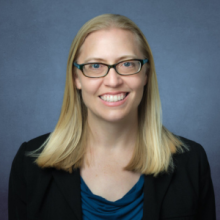
“The idea is to help providers in isolating environments come together to get peer support and expert guidance,” said Laura M. Wagner, PhD, RN, FAAN, professor, co-creator of the school’s new ECHO, and an internationally recognized leader in gerontological nursing.
The school’s ECHO is part of Project ECHO, a worldwide movement to provide specialized virtual collaboration sessions, free of charge. It was started in 2003 by Sanjeev Arora, MD, of the University of New Mexico, one of the few gastroenterologists in the state who treated patients with hepatitis C. After a patient in New Mexico died because she couldn’t access timely hepatitis C treatment, he started ECHO to educate providers and expand access to care.
“ECHO is a structure and format to reach out and create a community of clinicians interested in particular health care topics,” said Pamela Dudzik, MPP, program analyst, who is coordinating the school’s ECHO. “ECHO is very clear that it should be a collaborative environment where everyone is respected and given the opportunity to speak – ‘all teach, all learn’.”
In 2025 alone, there were 3,097 ECHO programs globally, which supported 342,000 frontline professionals in 198 countries and areas, benefiting a total of 116 million patients, according to Project ECHO’s 2025 impact report.
The Power of Community for Home-Based Clinicians
The School of Nursing knew that home-based providers needed support. “These kinds of clinicians are usually a practice of one,” said Gordon. “We rarely interact with other clinicians other than a phone call or an email.” Home-based health care clinicians can also experience anxiety and even fear, especially new graduates and clinicians who are transitioning to home-based care.
Through the generous support of an anonymous donor, the School of Nursing was able to fund the start-up costs for the ECHO and the infrastructure required to run one. This support also keeps the program free for participants, without having to rely on grant funding, as other ECHO programs often do.
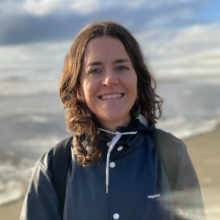
Monica Corbin, RN, a current student in the school’s BSN Entry to the Doctor of Nursing Practice program and a participant in the school’s ECHO, says she values the opportunity for shared problem solving. “Last session, a UCSF expert in palliative care joined us. One of the attendees, an at-home care nurse practitioner, was able to present a complicated case and hear ideas on managing a patient’s chronic pain,” said Corbin, adding that without the ECHO, it would have been difficult for the nurse practitioner to get that type of guidance.
Expanding to Support More At-Home Providers
Currently, the School of Nursing’s ECHO is focused on older adults, as that is typically who participates in UCSF’s Care at Home program, where the average patient age is 87. These patients also tend to have more complex cases where clinicians could use the kind of sounding board that the ECHO provides. But school leaders see this as just the start. “There are so many areas where we can expand,” said Wagner, such as home-based mental health and palliative care.
The school’s Home-Based Care Learning Collaborative ECHO started in late 2025 and has already drawn home-based caregivers from not just the San Francisco Bay Area, but other parts of the country and the globe — including a provider from Maine and a clinician from Malawi who provides at-home HIV care. The School of Nursing hopes that now that the program has gotten off the ground, school alumni — especially new graduates and those just beginning to provide home-based care — will join.
Gordon said that this format has been successful in bringing clinicians together so they can talk about their specific challenges in a more relaxed setting than health care providers may be used to. “In health care, the exchange of ideas is often very formal — through grand rounds and presentations — but this is a very different atmosphere,” she said. “We’re trying to make it much more collegial and collaborative."
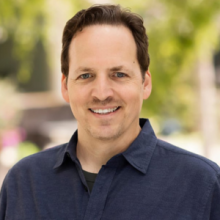
It’s an atmosphere participants notice and value. “One specific insight that has stayed with me was how collaborative and supportive the ECHO session felt,” said Daniel Gordon, NP, a geriatric nurse practitioner and ECHO participant. “The open exchange of ideas and shared experiences created a space where learning was both meaningful and directly applicable to my practice.”