
The Pediatric Nurse Practitioner
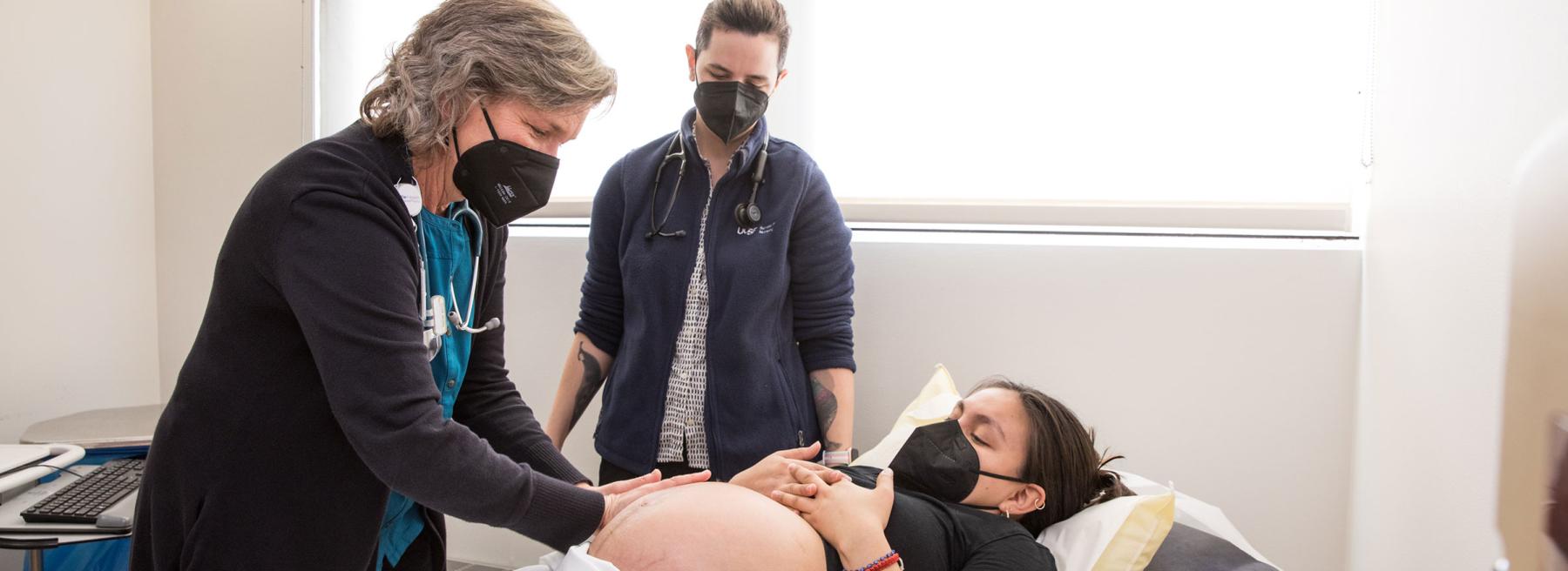
The Pediatric Nurse Practitioner provides advanced clinical practice in the care of children, across the health and illness continuum and across practice settings.

Pediatric Nurse Practitioner (PNP) Program
Students may choose to focus on becoming an Pediatric Nurse Practitioner (PNP) with expertise in pediatric primary health care and chronic illness for infants, children, and adolescents in community and clinic environments. The curriculum includes classroom and clinical experiences encompassing advanced health assessment, physiology and pathophysiology, management of common and complex health/illness conditions, family, child, and adolescent theory and development, nutrition, and advanced practice nursing role development.
There is a strong emphasis on addressing health disparities by preparing Pediatric Nurse Practitioners who have expertise to work with diverse, vulnerable, and underserved pediatric and adolescent populations.
Graduates of the program with a specialization in Advanced Practice Pediatric Nursing are prepared to become leaders in the care of children across the health and illness spectrum and across institutional boundaries. They are eligible for state licensure as a Nurse Practitioner and for national certification as a Pediatric Nurse Practitioner through the Pediatric National Certification Board (PNCB) and the American Nurses Credentialing Center (ANCC). This specialty area was formerly named "Advanced Practice Pediatric Nursing (APPN)."
Program Requirements and Recommendations
It is recommended that applicants have a minimum of one year pediatric nursing experience prior to commencing the PNP specialty content, and two years or more are highly recommended.
Fluency in spoken and written English is mandatory for acceptance into the program. Fluency in spoken and written Spanish is highly desirable. Due to sequencing of course requirements and clinical rotations, requests for a three-year or part time program of study should be identified prior to initiating coursework. The program is academically rigorous, and prospective students should plan to limit outside work commitments to no more than 60% full-time equivalent.
Courses/Curriculum
Coursework and clinical residency in the PNP program provides didactic and practical knowledge development in advanced pediatric health assessment; family/child/adolescent development and theory; pediatric physiology and pathophysiology; nutritional and pharmacologic management in pediatrics; clinical management of the pediatric patient in primary and chronic care, pediatric sociocultural and ethical issues, and professional role development for the PNP.
In the first year, courses are taken in the Graduate core curriculum, and clinical skills begin development in the primary care setting. In the second year, the program includes further specialty courses in pediatric care, and immersion into the PNP clinical role, with some clinicals in the specialty outpatient setting. A total of 600 clinical hours are required for national certification.
- PNP Curriculum Plan
Application
For information on UCSF SON MS Program application procedures:
Frequently Asked Questions
If you wish to provide health care to people across the lifespan or are planning on practicing in a rural area, the selection of the FNP program would be most appropriate.
If your interest, however, is in providing primary care to infants, children, and adolescents within a family context, the Pediatric NP program is most appropriate.
If you want to focus on primary care or outpatient specialty clinics with a strong background in providing primary care to a chronically ill population, the PNP program is recommended.
If you have a solid acute care nursing background, and wish to focus more on acutely ill children with a strong inpatient focus as an NP, the ACPNP program is probably most appropriate. You will have some primary care training in the ACPNP program but you will not receive certification to work in the primary care setting.
Full-time study is strongly recommended but not required. A limited number of part-time slots in the program may be available. Applicants seeking part-time status must declare this preference on their application. Please note that the program is academically rigorous; therefore prospective students need to plan for limited professional commitments and limited work of no more than 50-60% during their graduate study.
Note: part-time study is defined as 6 units or less per quarter.
The faculty will work with you to find the preceptors who are best suited for your area of specialization. Our experience is that students often provide input in selecting and planning their clinical experiences and participate in this process of selecting preceptors.
Masters Programs: An undergraduate GPA of 3.0 (on the 4.0 maximum scale) is expected for admission into the School of Nursing, although special circumstances can be discussed.
Doctoral Programs: an undergraduate Grade Point Average (GPA) of 3.2, and, if a graduate (master's) degree has been earned, a Grade Point Average of 3.5 is expected, verified by official transcripts.
Caution: transcripts from outside the USA require special handling.
Non-English transcripts or international transcripts (especially transcripts using different grading systems) should be submitted for translation and/or evaluation to a transcript evaluation agency.
The purpose of the evaluation is to verify that your degree/coursework is the equivalent to that of a US Bachelor or Master's degree.
Evaluation agencies provide a variety of services. Be sure to request an evaluation that provides the following:
- Lists all subjects/courses completed at the post-secondary level
- Provides a U.S. semester credit and grade equivalent for each course
- Provides a U.S. grade point average (GPA) for the Bachelor's degree or its equivalent on a 4.0 scale, and
- Designates the level (upper or lower) of each undergraduate course
Un-translated non-English transcripts will not be accepted.