
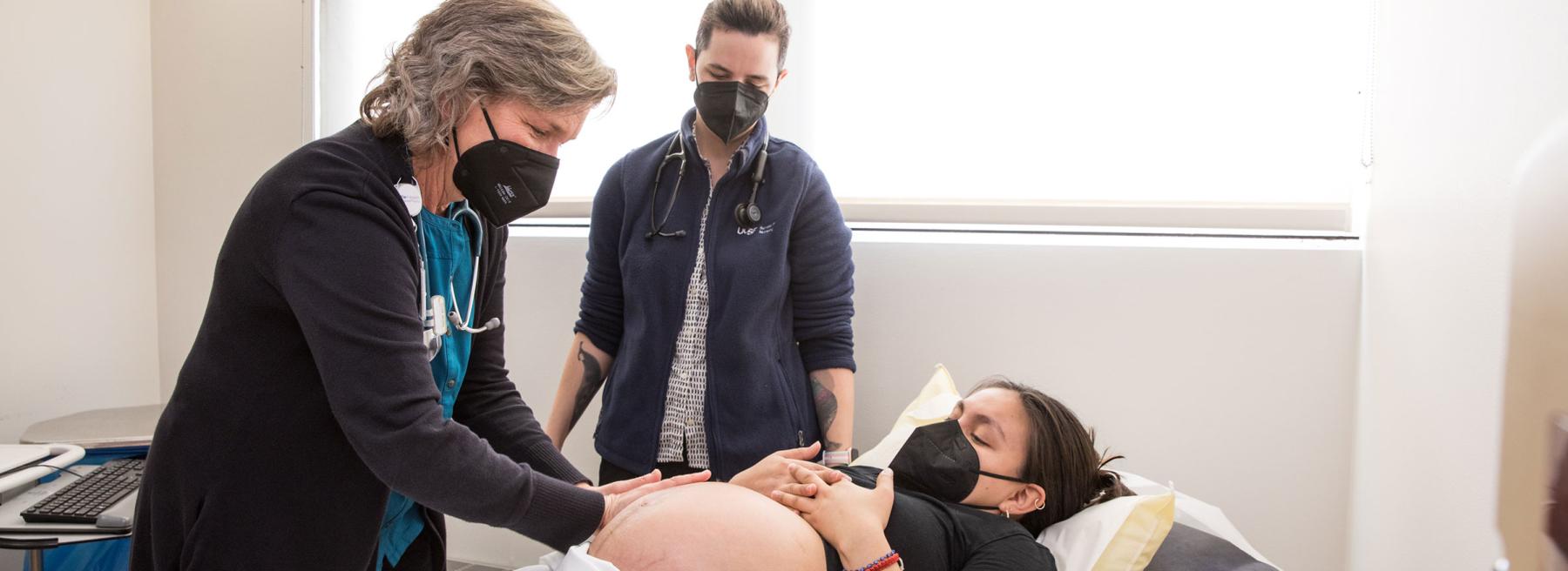
UCSF Nursing students in the MS program may select the Occupational and Environmental Health Nursing specialty area.
OEH faculty members also work with students seeking the Doctor of Philosophy (PhD) degree.
OEH Nursing MS Specialty Area Choices
• Adult-Gerontology Nurse Practitioner - Occupational and
Environmental Health Focus (AGNP-OEH)
• Occupational and Environmental Health Specialists (OEHS)
Occupational and Environmental Health Adult-Gerontology Nurse Practitioners (AGNP-OEH) focus on direct patient care, the theory and practice of adult health maintenance, and the assessment and management of common ailments facing working adults, including occupational injuries and illnesses. Graduates are eligible for state and national board certification. Detailed information about certification is available on the AGNP web page.
Occupational and Environmental Health Specialists focus on programs to prevent occupational illnesses and injuries, to manage disability, and to provide consultation with employers, employees and others as well as worker education and training. This role preparation provides a streamlined MS program for those who seek specialization in occupational and environmental health nursing without a direct patient care component.
Curriculum
All OEHN students take courses that explore research in occupational health, hazard assessment, program planning, OEHN roles, and management of occupational health problems. Clinical residencies in specialty clinics and occupational health settings provide a range of experience with experts in the field. Students also complete program development projects at businesses, medical centers, community based organizations, or government organizations. Topics for these projects have included worker education and training, ergonomics, protection from toxic hazards, medical surveillance systems, regulatory compliance systems, emergency response teams, and international travel and disease prevention.
OEHN curriculum details are provided below:
- AGNP-OEH Curriculum Plan: ohnp-curr.pdf
- OEHS Curriculum Plan: oehs-curr.pdf
Most students finish the program in two academic years (AGNP-OEH) or one calendar year (OEH Nurse Specialist) and complete a written comprehensive exam (or, in some instances, a thesis). Students may apply to extend their program over three years.
Other Application/Degree Options
Applicants who have a bachelor's degree in a field other than nursing (and who are not registered nurses) may be interested in our three-year Master's Entry Program in Nursing (MEPN). MEPN students who are interested in the OEHN specialty can enter the OEHN MS program in their second UCSF year, with the approval of the OEHN program. Please consult the MEPN program web page for more details about this option.
Additionally, MS students may apply to the UC Berkeley School of Public Health (http://sph.berkeley.edu) for a Master of Public Health (M.P.H.) degree. This one-year program, designed for health professionals, consists of 42-units of academic credit some of which may be transferred from UCSF to UC Berkeley for elective credits.

Doctoral Program
The PhD Program in Occupational and Environmental Health focuses on theory development, design and methodology of research, and the specialized knowledge of occupational or environmental health. Each candidate’s curriculum is tailored to their individual career goals and past experience in occupational and environmental health. For more information about the doctoral program at UCSF School of Nursing, please refer to the following web page: http://nursing.ucsf.edu/programs/phd-nursing.
UC Center for Occupational and Environmental Health (COEH)
This program is a component of UC's Northern California Center for Occupational and Environmental Health (COEH), a multi-campus Educational Research Center funded by the National Institute for Occupational Safety and Health (NIOSH), which has offered training stipends to OEHN students for more than twenty-five years. The COEH affiliation offers students the opportunity for interdisciplinary training in occupational health with occupational medicine fellows and students in industrial hygiene, epidemiology, and ergonomics.
Visit COEH at http://coeh.berkeley.edu (website).
Career Opportunities
OEHN graduates develop careers in a variety of settings including on-site employee health clinics in various industries, hospital-based primary care or specialty clinics, occupational health service or consulting companies, government agencies, academia, and communities.
Frequently Asked Questions
Each applicant is reviewed as a whole.
Goal statement, letters of reference, extracurricular activities, language skills, activities on-the-job, research activities, work experience, professional organization activities, and Grade Point Average (GPA) are ALL considered when the application is reviewed.
List all of these aspects.
Be sure to ask colleagues to review your goal statement. Include examples of on-the job activities. Describe any volunteer and professional activities. Make sure to ask your colleagues for "excellent" references and have them give specific reasons why they believe in your success.
Masters Programs: An undergraduate GPA of 3.0 (on the 4.0 maximum scale) is expected for admission into the School of Nursing, although special circumstances can be discussed.
Doctoral Programs: an undergraduate Grade Point Average (GPA) of 3.2, and, if a graduate (master's) degree has been earned, a Grade Point Average of 3.5 is expected, verified by official transcripts.
Caution: transcripts from outside the USA require special handling.
Non-English transcripts or international transcripts (especially transcripts using different grading systems) should be submitted for translation and/or evaluation to a transcript evaluation agency.
The purpose of the evaluation is to verify that your degree/coursework is the equivalent to that of a US Bachelor or Master's degree.
Evaluation agencies provide a variety of services. Be sure to request an evaluation that provides the following:
- Lists all subjects/courses completed at the post-secondary level
- Provides a U.S. semester credit and grade equivalent for each course
- Provides a U.S. grade point average (GPA) for the Bachelor's degree or its equivalent on a 4.0 scale, and
- Designates the level (upper or lower) of each undergraduate course
Un-translated non-English transcripts will not be accepted.
Many of our students find that sharing housing is a good approach to solving both the availability and cost issues. Housing in the San Francisco Bay Area may be expensive, but help can be found with the campus Housing Office, the Student Affairs Office, and previous graduates can often give advice.